Read the article
What Is a Febrile Seizure?
Febrile seizures are convulsions triggered by a rapid rise in body temperature, usually as a result of an infection.1 This disrupts brain activity, leading to loss of consciousness, irregular breathing, and jerking movements, which typically last under 5 minutes. Febrile seizures typically happen within a few hours of illness and with a fever above 102°F (39°C), but they can also occur at lower temperatures or before any symptoms appear.2
Who Is at Risk?
Febrile seizures affect 2%-5% of children aged 6 months to 5 years, but they most commonly occur between 12 and 18 months.3 Risk is higher in children with an underlying neurologic disorder or a family history of febrile seizures.3
Are They Dangerous?
In most cases, febrile seizures are not harmful and do not lead to neurologic problems or developmental delays.3
Will My Child Have More Seizures?
Around 30% of children who have a febrile seizure will have another, but this risk decreases as they get older.3 Children who experience a febrile seizure have a slightly higher risk of developing lifelong seizures, about 1% more than the general population.4 Although fever-reducing medications like acetaminophen or ibuprofen can help ease the discomfort of a fever, there is no medication to prevent developing a febrile seizure.
What to Do if Your Child Is Having a Febrile Seizure
Although distressing to witness, stay calm and monitor the child to ensure their safety.
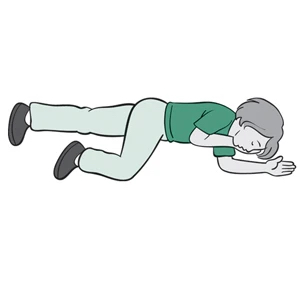
Figure 1. Recovery position.6
Protect your child from injury: Ensure they’re in a safe place, like on the floor or in bed, with enough space to move freely without injury.
Position your child: Gently turn your child onto their side into the recovery position (Figure 1). This will allow vomit or saliva to drain and minimize choking.
Do not place anything in their mouth: A common misconception; don’t put anything in their mouth or try to hold their tongue, as this can cause harm.
Postseizure care: After the seizure, your child may feel confused or sleepy. Let them rest as they gradually recover.
Seek medical care: Call 911 or go to the nearest emergency department if a seizure lasts more than 5 minutes, or if the child doesn’t wake up or return to normal afterward. Be sure to follow up with your pediatrician to discuss the febrile seizure.
SOURCES
- Han JY, Han SB. Pathogenetic and etiologic considerations of febrile seizures. Clin Exp Pediatr. 2023;66(2):46-53. doi: 10.3345/cep.2021.01039
- Mosili P, Maikoo S, Mabandla MV, Qulu L. The pathogenesis of fever-induced febrile seizures and its current state. Neurosci Insights. 2020;15:2633105520956973. doi: 10.1177/2633105520956973
- Sawires R, Buttery J, Fahey M. A review of febrile seizures: recent advances in understanding of febrile seizure pathophysiology and commonly implicated viral triggers. Front Pediatr. 20223;9:801321. doi: 10.3389/fped.2021.801321
- Lee SH, Byeon JH, Kim GH, Eun BL, Eun SH. Epilepsy in children with a history of febrile seizures. Korean J Pediatr. 2016;59(2):74-79. doi: 10.3345/kjp.2016.59.2.74
- Renda R, Yüksel D, Gürer YKY. Evaluation of patients with febrile seizure: risk factors, recurrence, treatment, and prognosis. Pediatr Emerg Care. 2020;36(4):173-177. doi: 10.1097/PEC.0000000000001173
- Daly E. How to put a child and baby in the recovery position. MadeForMums. Accessed April 3, 2025. https://www.madeformums.com/school-and-family/how-to-put-a-child-and-baby-in-the-recovery-position/