Read the article
WHAT IS “SAFE SLEEP”?
Safe sleep means creating a sleeping space for your baby that reduces the risk of sudden unexpected infant death (SUID), which includes sudden infant death syndrome (SIDS), and accidental suffocation during sleep. These events usually happen during sleep and are most common in babies under one year old.1,2
WHAT YOU CAN DO AT HOME
- Always place your baby on their back to sleep, even for naps.2-4
- Use a firm, flat mattress/surface with only a fitted sheet.2-4
- Only use sleep products, such as cribs, bassinets, portable cribs, and play yards, that meet current Consumer Product Safety Commission standards.5
- Keep the sleeping area free of toys, blankets, pillows, and bumper pads.2-4
- Have your baby sleep in the same room (but not the same bed) for at least 6 months.3,4
- Don’t allow the baby to overheat: Dress them in light clothing to sleep and keep the room cool and comfortable.3,4
- Remember that breastfeeding and pacifier lower the risk of SIDS.3,4
- Do not smoke during pregnancy or after your baby is born. Even secondhand smoke is dangerous. If smoking cannot be avoided, always smoke outdoors and use a designated jacket that stays outside to reduce bringing smoke particles near your baby.1,2
Know the ways a baby’s airway can be blocked:
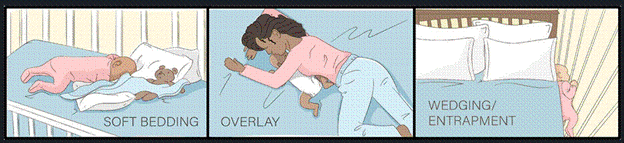
Illustrations courtesy of the Centers for Disease Control and Prevention.1
BASIC TIPS FOR A HEALTHY BABY AND PARENT
- Nutrition: Eat well and stay hydrated, especially to support milk production if breastfeeding.2
- Rest: Try to rest/sleep when your baby sleeps. Caring for the baby is hard work.2
- Avoid risky items: Keep your baby’s sleep area simple and clutter-free. Avoid using sleep positioners or products that claim to prevent SIDS unless approved by a doctor.3,4
- Remember the “ABCs”: Babies sleep best Alone, on their Back, and in their Crib.2,3
WHEN TO CALL THE DOCTOR
- If your baby has trouble breathing during sleep. It’s normal for newborns to pause breathing for up to 10 seconds, then breathe quickly again. This is called periodic breathing. Call your doctor if the pauses are longer, the baby turns blue, or they seem limp or unresponsive.4
- If your baby starts rolling onto their stomach and you’re unsure how to keep sleep safe.2
- You’re unsure about how to set up a safe sleep practice.2
- If you have concerns or questions about how your baby sleeps.2
HELPFUL RESOURCES
- Safe to Sleep: https://safetosleep.nichd.nih.gov/
- HealthyChildren.org (AAP): https://www.healthychildren.org
- CDC Infant Sleep Safety: https://www.cdc.gov/sudden-infant-death/
- Consumer Product Safety Commission standards and recall notifications: https://www.cpsc.gov/
REFERENCES
Centers for Disease Control and Prevention. Sudden unexpected infant death and sudden infant death syndrome. Updated January 2024. Accessed May 5, 2025. https://www.cdc.gov/sudden-infant-death/
National Institute of Child Health and Human Development. Safe sleep environment for baby [Internet]. Safe to Sleep®. https://safetosleep.nichd.nih.gov/reduce-risk/safe-sleep-environment. Accessed May 5, 2025.
Moon RY, Carlin RF, Hand I; Task Force on Sudden Infant Death Syndrome and the Committee on Fetus and Newborn. Sleep-related infant deaths: updated 2022 recommendations for reducing infant deaths in the sleep environment. Pediatrics. 2022;150(1):e2022057990. doi:10.1542/peds.2022-057990.
Kondamudi NP, Krata L, Wilt AS. Infant apnea. In: StatPearls [Internet]. Treasure Island (FL): StatPearls Publishing; 2025 Jan–. Updated 2023 Aug 12. Available from: https://www.ncbi.nlm.nih.gov/books/NBK441969/
Moon RY, Darnall RA, Feldman-Winter L, Goodstein MH, Hauck FR; Task Force on Sudden Infant Death Syndrome. SIDS and other sleep-related infant deaths: Updated 2016 recommendations for a safe infant sleeping environment. Pediatrics. 2016;138(5):e20162938. doi:10.1542/peds.2016-2938.