

Janel H. Johnson, DO, FACOFP
This paper was submitted as part of Dr. Johnson's application for ACOFP Fellowship and received the Most Outstanding Paper Crest Award. ACOFP Fellowship recognizes exceptional national, state, and local service through teaching, authorship, research, or professional leadership. Visit the ACOFP Fellows page to learn more about fellowship and apply.
Introduction
While the death of a patient is an occurrence all physicians will have to face at some time in their career, the COVID-19 pandemic made it a more routine and typically earlier experience for Osteopathic Medical Students (OMS) and Physician Assistant (PA) students as well as the medical community at large (1, 2). Bearing this in mind: what is a better way to introduce this subject to our student doctors? At Oklahoma State University College of Osteopathic Medicine (OSU-COM) and OSU- COM at the Cherokee Nation (OSU-COM CN), we are utilizing a novel approach of a simulated patient death in the simulation center with Manikins to give learners an opportunity to experience this in a safe and controlled environment.
Objectives
The objectives of our simulation were for our learners to have a simulated Advance Directive discussion with the simulated patient and experience the death of the simulated patient in a safe and controlled environment. The objectives of our evaluation was to determine if this simulation was successful at creating a safe and guided simulation and if the simulation is worth continuing.
Methods
An End-of-Life Simulation was conducted in our simulation centers on Nov. 4, 2021, and Nov. 11, 2021. The learners (Osteopathic Medical Students Year II (OMS-II) and Physician Assistant Students Year 1 (PA-1)) were split into groups of six to seven and sent through an hour and 50-minute simulation and debrief where the mannikin patient declined into death. This was standardized as much as possible with facilitator guides, simulation templates, and voice actor scripts (see Appendices A, B, and C). On Nov. 22, 2021, the first round of an anonymous, mixed-methods evaluation SurveyMonkey with a revised Thanatophobia scale (Appendix D) was sent to those students to determine their view of the experience and its utility. The survey concluded on Dec. 10, 2021. In the summer of 2023, those same students were sent a second survey over their simulation experience now geared toward their clinical experience with the original Thanatophobia scale (Appendix E). This report will discuss the combined results.
Sample Size
The entire class size of OMS-II and PA-S1 was 192 in the fall of 2021. Of those, 52 (27.2%) completed the evaluation survey. There is a caveat to add; this survey was sent out on Nov. 22, 2021. On Nov. 24, 2021, unfortunately one of our students passed away. After that date, we only received six responses of the 52. While we have not surveyed the students over this instance, it is within reason that this event may have decreased the response rate. Those same students were sent the second-round survey in the summer of 2023. From that, 50 learners opened the survey and 44 consented to the terms of it. Of those 2 were lost to attrition during the survey. Altogether 42 students completed the full survey to the end. This gives a response rate of 21% of the two classes.
Demographics
| Year | OMS CHS | OMS CN | PA |
|---|---|---|---|
| 2021 | 32 | 13 | 8 |
| 2023 | 25 | 15 | 4 |
Results
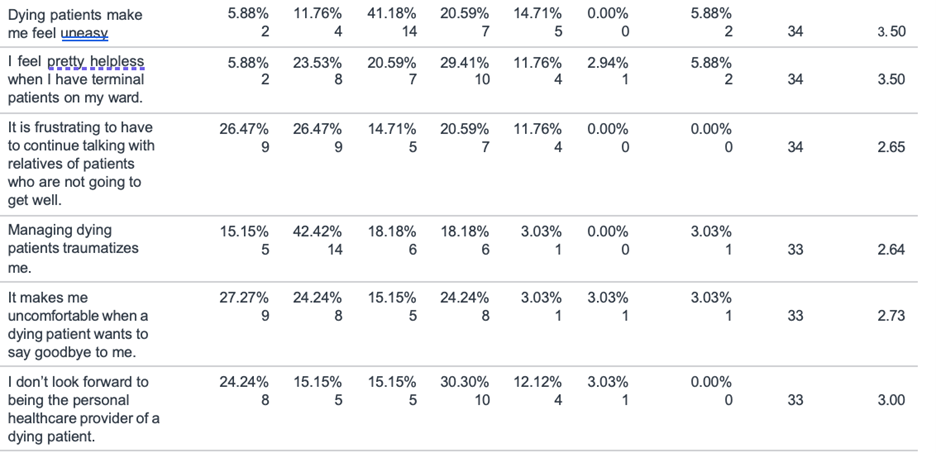
The qualitative portion of the results were analyzed using an inductive approach. The Thanatophobia Scale was revised for the 2021 survey to reflect not having had experience as a primary caregiver to a terminal patient and used in original form for the 2023 survey.
Question 7
2021: I found the End-of-Life Simulation worth participating in.
2023: Looking back at the End-of-Life simulation experience, I have found that it was worth participating in.
| Year | Yes | No | Prefer Not to Answer |
| 2021 | 49 | 2 | 1 |
| 2023 | 39 | 3 | - |
Question 8
2021: Please reflect on your answer of "Yes" to I found the End-of-Life Simulation worth participating in. Why did you make that selection?
2023: Please reflect on your answer above. Why did you make that selection?
| Year | Dominant Theme | Secondary Theme | Secondary Theme | Secondary Theme | Secondary Theme | Secondary Theme |
| 2021 | Good exercise/experience (36) | Safe/Guided Experience (11) | Explore Emotions (9) | Family Communication (8) | Advance Directive/Legal Aspects (8) | Interprofessional (6) |
| 2023 | Preparation (24) | Processing (9) | Controlled Setting (6) | Helpful (3) |
Discussion on these themes:
In 2021, learners noted that the good exercise/experience theme related to going through the process of a death and the acuteness of this as well as dealing with a patient who did not go along with their recommendations. In 2023, this was reinforced with learners noting that the experience had prepared them for clinical and allowed them to practice their skills. The learners reported similarly related secondary themes from explore emotions to processing with focusing on how this simulation let them self-reflect on emotions before having to deal with this in real time. The safe/guided experience and controlled settings themes were also reciprocated between the surveys in that the learners liked having this simulation in a space that was not as chaotic as real life and with time to process. In 2021 there were three themes that came out of the analysis that were not reflected in the 2023 survey:
- Family communication – 8 respondents
- Definitions – This theme centered around respondent’s experience with the family member from the simulation.
- Advance Directive/Legal Aspects – 8 respondents
- Definition – This theme centered around the use of advance directives and other legal scenarios represented in the simulation.
- Interprofessional – 6 respondents
- Definition – This theme centered around the interprofessional team that some learners experienced in this simulation. The PA-S were only in the Tulsa cohort.
In 2023, the helpful theme was just that, that the learners found it helpful and did not elaborate on further details.
The “No” answers to Question 7 were deemed outliers and there were no themes for Question 9 on the 2021 survey or Question 8 on the 2023 survey.
Question 10, 2021: When thinking about your upcoming clinical rotations, do you think this simulation will help you navigate a terminal patient?
Question 9, 2023: While thinking about your clinical rotations, do you think this simulation has helped you navigate a terminal patient?
| Year | Yes | No | Prefer Not to Answer | Skipped |
| 2021 | 48 | 1 | 1 | 3 |
| 2023 | 24 | 3 | - | - |
An additional category was listed for the 2023 study: “I have not had a terminally ill patient.” 11 learners selected this and were sent to Question 11 in that survey.
Question 11, 2021: Please reflect on your answer of "Yes" to “When thinking about your upcoming clinical rotations, do you think this simulation will help you navigate a terminal patient?”
Question 10, 2023: Please reflect on your answer above. Why did you make that selection?
| Year | Dominant Theme | Secondary Theme | Secondary Theme |
| 2021 Q11 | Exposure (27) | Advance Directive/Legal Aspects (15) | Family Communication (11) |
| 2023 Q10 | Preparation (9) | Processing (3) |
Discussion on these themes:
In 2021, learners noted that even this short exposure increased their confidence in having to deal with this sensitive topic and this was carried forward in 2023 with the learners stating that it had indeed helped them practice their skills when the time came. In 2021, the learners noted that going through the process of developing an Advanced Directive and discussing that with family expanded their understanding of the boundaries of the business. In 2023, the learners again cited that the simulation encouraged self-reflection on their role and emotions for this experience. For the learners in 2021, the talk with the family and engaging and describing to them what is going on with their loved one through the death process was an important facet.
Question 12 from the 2021 survey only had one respondent and was deemed an outlier.
Question 11, 2023:
While thinking about your clinical rotations, do you think the End-of- Life simulation will help you navigate a terminal patient (only those who answered, “I have not had a terminal patient” on Question 9 were directed to this question)?
- Yes – 10
- No – 0
- 1 learner lost to attrition at this question.
Question 12, 2023: Please reflect on your answer above. Why did you make that selection? (Only those who were directed to Question 11 moved to this question).
Out of the 10 learners directed to this question, only 7 responded, all had the same theme of preparation. Learners expressed the simulation prepared them for clinical practice and helped them practice their skills.
Question 13, 2021: Revised Thanatophobia Scale
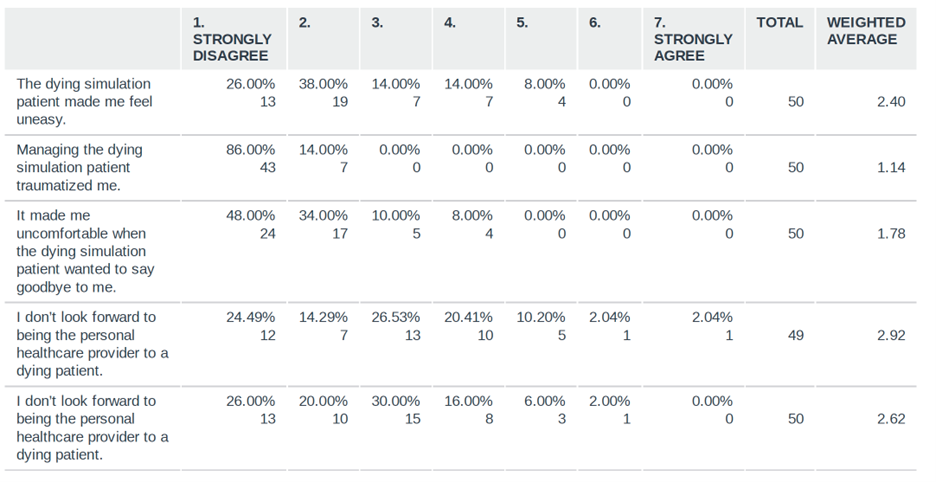
Unfortunately, there was a mistake in the final survey with the last question being duplicated instead of the appropriate question being added which was: When the simulation patient began discussing death, I became uncomfortable. This was addressed in the 2023 version.
Merrill J, Lorimor R, Thornby J, Woods A. Caring for terminally ill persons: comparative analysis of attitudes (thanatophobia) of practicing physicians, student nurses, and medical students. Psychological reports. 1998; 83(1): 123-128.
Question 13 – 2023
Thanatophobia Scale

Merrill J, Lorimor R, Thornby J, Woods A. Caring for terminally ill persons: comparative analysis of attitudes (thanatophobia) of practicing physicians, student nurses, and medical students. Psychological reports. 1998; 83(1): 123-128.
Discussion
The results of both rounds of the evaluation survey show that our objectives of creating a simulation that was both safe and well guided were successful. We also learned that the majority of the learners who responded want the simulation to continue. When reviewing the Thanatophobia scales from the simulation versus personal experience with an actual patient, it is clear that the simulation mannikin did not effect the students as acutely as the real world patient. However, the “I don’t look forward to being the personal healthcare provider of a dying patient,” domains were similar in weight between each cohort. Some other unexpected aspects of the simulation themes included the self-reflection and processing themes.
In discussion with Dr. Nicole Farrar, Medical Education Department Chair and CHS campus coordinator, we have both heard from students and faculty facilitators that this is one of their favorite experiences. The early-stage practice from the emotional and practical aspects (such as modeling the death exam) we believe will have long term effects, even into residency. We have observed a catharsis during the debrief section amongst both student learners and faculty regarding our own familiarities around death and the process of dying. This was unexpected secondary outcome that we have come to appreciate.
Conclusions
The End-of-Life simulation is successful in its objectives. However, there is only so much preparation that can be given to medical professionals on the process of dying and the death of a patient. This will continue to be a learning and challenging experience for all medical professionals.
Future Research and Interventions
While this simulation is a good start in the early medical education years, continued spaced repetition throughout the clinical years and into residency may be needed to create less anxiety and trepidation as well as processing of the dying patient. It may also be of use to offer space for all medical professionals to have to process after the death of a patient. Not just the medical aspects of this process, but also the feelings around the experience.
References
- Ho CY, Kow CS, Chia CHJ, Low JY, Lai YHM, Lauw SK, How AEH, Tan LHE, Ngiam XLL, Chan NPX, Kuek TYJ, Kamal NHA, Chia JL, Abdurrahman ABHM, Chiam M, Ong YT, Chin AMC, Toh YP, Mason S, Krishna LKR. The impact of death and dying on the personhood of medical students: a systematic scoping review. BMC Med Educ. 2020 Dec 28;20(1):516. doi: 10.1186/s12909-020-02411-y. PMID: 33371878; PMCID: PMC7768997.
- Wallace CL, Wladkowski SP, Gibson A, White P. Grief During the COVID-19 Pandemic: Considerations for Palliative Care Providers. J Pain Symptom Manage. 2020 Jul;60(1):e70-e76. doi: 10.1016/j.jpainsymman.2020.04.012. Epub 2020 Apr 13. PMID: 32298748; PMCID: PMC7153515.
For additional information on this study, please download the appendices, which provide full versions of the training materials.